
XL or standard: the page yields the makers actually print
By Which Ink Fits · Last verified 21 Nov 2026
XL is not one multiple. HP's 67XL is about twice the 67. Epson's 212XL black is 500 pages against 150. Brother's color XL is 5,000 against 1,500. Canon does not print an XL of PG-243 at all.
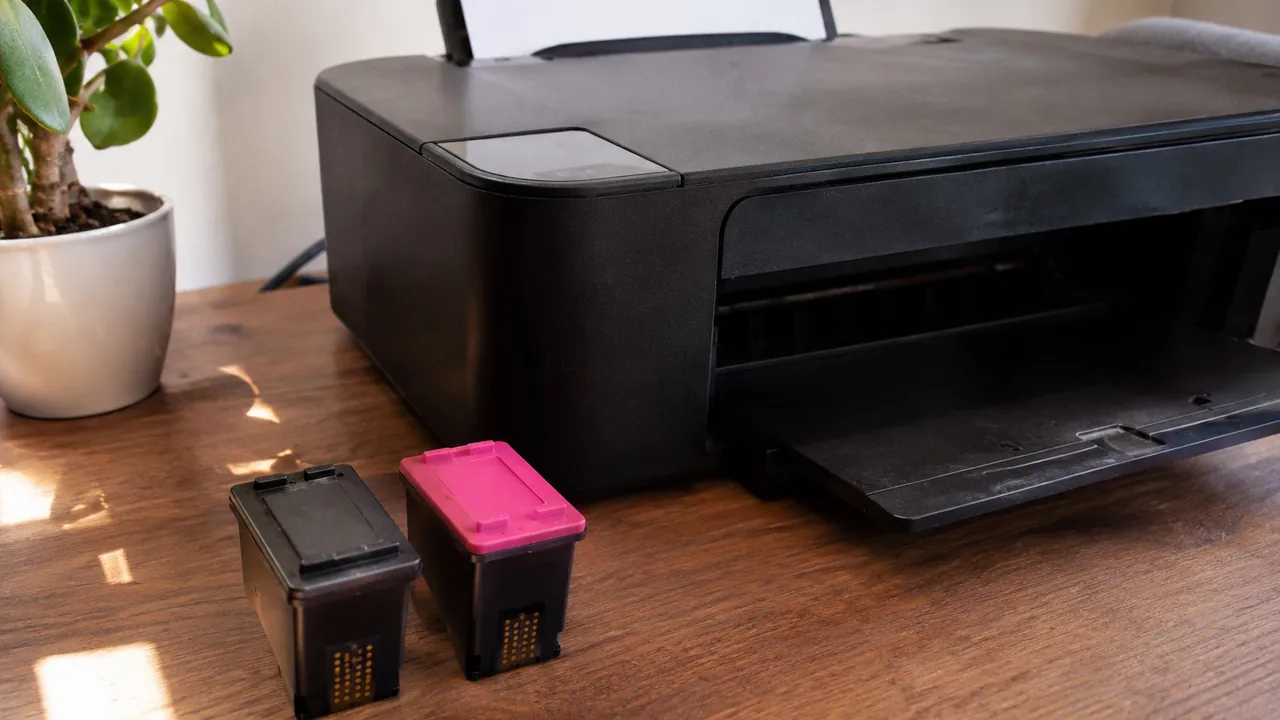
The counts below are replacement yields, the kind of figure you use when the cartridge in the printer is empty and you buy another. They are not the "year of ink in the box" lines some printer pages also print. Each figure is tied to the page that prints it, opened 21 Nov 2026. Where a page did not print a number, this guide does not fill one in.
| Cartridge | Standard, as printed | Larger size, as printed | How many times | What the footnote names |
|---|---|---|---|---|
| HP 67 black | 3YM56AN, about 120 pages | 3YM57AN, about 240 pages | 2 times | ENVY 6000 series |
| HP 67 tri-color | 3YM55AN, about 100 pages | 3YM58AN, about 200 pages | 2 times | ENVY 6000 series |
| Epson 212 black | 150 ISO pages | 212XL, 500 ISO pages | 3 and 1/3 times | ISO/IEC 24711, default mode |
| Epson 212 color | 130 ISO pages | 212XL, 350 ISO pages | between 2 and 3 times | ISO/IEC 24711, default mode |
| Brother LC406 black | LC406BK, 3,000 pages | LC406XLBK, 6,000 pages | 2 times | ISO/IEC 24711, approximate |
| Brother LC406 color | 1,500 pages each | 5,000 pages each | 3 and 1/3 times | ISO/IEC 24711, per cartridge |
| Canon PG-243 black | 100 pages, no XL of this number | PG-245 is 180; PG-245XL is 300 | different part numbers | TS302a spec cell |
| Canon CL-244 color | 100 pages, no XL of this number | CL-246 is 180; CL-246XL is 300 | different part numbers | TS302a spec cell |
HP 67: about twice, and the test printer is not a DeskJet
HP's US shop page for 67 black, 3YM56AN, prints about 120 pages. The 67XL black, 3YM57AN, prints about 240. Tri-color is 3YM55AN at about 100 and 3YM58AN at about 200. The 67XL tri-color page also says you can print up to two times as many pages with a high yield cartridge. The black pages say the high yield prints more pages than the standard. They do not repeat the words "two times," but 240 against 120 is twice, and 200 against 100 is twice.
Every one of those footnotes says the same thing about the test. It was the HP ENVY 6000 All-in-One Printer series. The average is based on ISO/IEC 24711 or HP's testing method, and on continuous printing. Actual yield varies considerably with the content of the pages. The "or" matters. HP is not saying the number is only the ISO test. Details are deferred to hp.com/go/learnaboutsupplies. That address redirected, on 21 Nov 2026, to a page that did not itself print these four yields.
HP's ENVY 6055e shop page prints all four yields in one paragraph, with the same part numbers, and points at the same learn-about-supplies address. It does not say the 6055e was the unit in the test lab. The footnote on the cartridge pages names the ENVY 6000 series. Our DeskJet 2700 hub uses this ink on twelve models. The yield was not measured in those DeskJets. The HP 67 page is the list of printers.
Epson 212: black stretches further than color
Epson's WorkForce WF-2830 page prints one pair of ISO page counts. Standard 212 is black 150 and color 130. High capacity 212XL is black 500 and color 350. Footnote 6 says replacement cartridge yields are based on ISO/IEC 24711 tests in default mode, printing continuously. It also says yields vary with the images, the settings, temperature, and humidity, and that part of the ink from the included cartridges is used for printer startup. The page prints one color number, not a separate count for cyan, magenta, and yellow.
500 divided by 150 is 3 and 1/3. 350 sits between two times 130 (260) and three times 130 (390). So on Epson's own counts, the black XL is a larger jump than the color XL. The four printers we group on Epson 212 share these cartridge numbers. The yield line we are quoting is the WF-2830 page.
Brother LC406: color is a bigger jump than black
Brother's MFC-J4335DW page was marked Discontinued when opened 21 Nov 2026. The replacement footnote was still there. It says all page yields are approximate and calculated to ISO/IEC 24711. LC406BK is 3,000 pages. Each LC406 cyan, magenta, and yellow cartridge is 1,500. LC406XLBK is 6,000. Each LC406XL color cartridge is 5,000. The feature line above that footnote says "up to" 3,000 black and 1,500 color, or "up to" 6,000 black and 5,000 color.
Black XL is twice the standard black. Color XL is 3 and 1/3 times the standard color, because 5,000 divided by 1,500 is 3 and 1/3. That is the reverse of the Epson pattern, where black was the bigger jump. Brother's color figure is per cartridge. Epson's color figure is one number for "color." The LC406 page keeps the longer note on the in-box "year of ink" line, which is a different sum and is not repeated here.
Canon PG-243: the larger cartridge is a different number
Canon's PIXMA TS302a support page prints PG-243 black at 100 pages and CL-244 color at 100 pages, with fills of 5.6 ml and 6.2 ml. It does not print a PG-243XL or a CL-244XL. The next line is PG-245 and CL-246: 180 and 180 standard, 300 and 300 XL. Those are other part numbers. Our PG-243 page says which of our printer links include them, and where the TS302a itself is not yet a model page.
The TS302a cell does not contain the word ISO. Canon's measurement page says the mixed text and graphics yield is declared to ISO/IEC 24711. This guide leaves that distinction in view instead of stamping ISO onto a cell that does not say it.
Keep reading
- HP 67: which printers it fits
The family whose shop pages print about 120 and about 240 black pages.
- Epson 212 printers
Four models grouped on Epson's part number table.
- Brother LC406 printers
Where the 3,000 and 6,000 page footnotes are already spelled out.
- Image policyCanon PG-243 and CL-244
100 pages each, and no XL of this number.
Cost per page, without a made-up price
Cost per page is the price you pay, divided by the approximate yield in the table. On a clean double, the XL costs less per page only when its price is less than twice the standard cartridge. HP's black and tri-color 67 rows are that kind of double. Epson's black 212 row is 3 and 1/3, so the XL can cost up to 3 and 1/3 times the standard black and still match it per page. Brother's color row is the same 3 and 1/3. Canon's PG-245 at 180 pages is 1.8 times PG-243's 100, and it is not an XL of PG-243, so the prices are not prices of two sizes of one number.
None of that is a dollar figure, because the pages did not print one we can use. On 21 Nov 2026 the four HP 67 shop pages showed an MSRP label, a line reading $1.99 per month, and $0.00. A zero is not a shelf price. A monthly line is not the price of the cartridge in your hand. Brother's printer page shows a printer price, which is not an LC406 price. Epson's WF-2830 page prints yields and does not print a cartridge price. Dividing any of those by the yield would invent a cost. Bring the price on the box, or on the shelf, and divide it by the yield in the row that matches the number on that box.
Two further cautions, both from the footnotes rather than from us. The yields are approximate and were measured by continuous printing, so a printer that sits for weeks can use more ink on cleaning than these rows show. And a standard black beside an XL color is fine only where that maker says the printer accepts both. This guide does not add a permission the maker page does not print.
Frequently asked questions
Does XL always mean twice the pages?
No. On the HP 67 pages checked 21 Nov 2026, the XL is about twice the standard for black (about 240 against about 120) and for tri-color (about 200 against about 100). Epson's WF-2830 page prints 500 ISO pages for 212XL black against 150 for 212 black. Brother's color XL is 5,000 pages against 1,500. Canon does not print an XL of PG-243.
Is the higher yield a lower cost per page?
Only if the price you pay for the larger cartridge is less than its yield multiple times the smaller one. Divide the price by the approximate yield. The maker pages opened 21 Nov 2026 did not print a cartridge shelf price this page will use. HP's US shop pages showed $0.00 beside an MSRP label and a $1.99 per month line. Neither is a price for one cartridge.
Were these yields measured in my printer?
HP's 67 footnotes say the test printer was the ENVY 6000 All-in-One series. Epson's footnote says ISO/IEC 24711 in default mode, printing continuously. Brother says the LC406 counts are approximate and calculated to ISO/IEC 24711. Canon's TS302a cell prints 100 pages and does not name the test printer in that cell.
Sources
- HP 67 Black Original Ink Cartridge, 3YM56AN
- HP 67XL High Yield Black Original Ink Cartridge, 3YM57AN
- HP 67 Tri-color Original Ink Cartridge, 3YM55AN
- HP 67XL High Yield Tri-color Original Ink Cartridge, 3YM58AN
- HP ENVY 6055e shop page (prints the same four yields)
- Epson WorkForce WF-2830
- Brother MFC-J4335DW
- Canon Support for PIXMA TS302a
- How Page Yields Are Measured, Canon U.S.A.
- Retrieved 21 Nov 2026.
Which Ink Fits is independent and is not the manufacturer. Match the number on your printer and on the box, then confirm it on the source page.
Related reading
- DeskJet 2700 series hub
Twelve models that share 67 and 67XL, with the yield notes kept on the hub.
- Canon PG-245 and CL-246
The larger Canon numbers, including an XL, from the same spec row.
- Find the model number
Read the name on the printer before you compare yields.
- Ink cartridge, toner, or bottle?
A toner XL and an ink XL are not the same kind of supply.